AI
AI-native program. We teach you how to apply AI in practice
70% of training is practical on real projects
A portfolio of 3 projects that employers will appreciate
Career support for successful employment
Who is Vibe Coder?
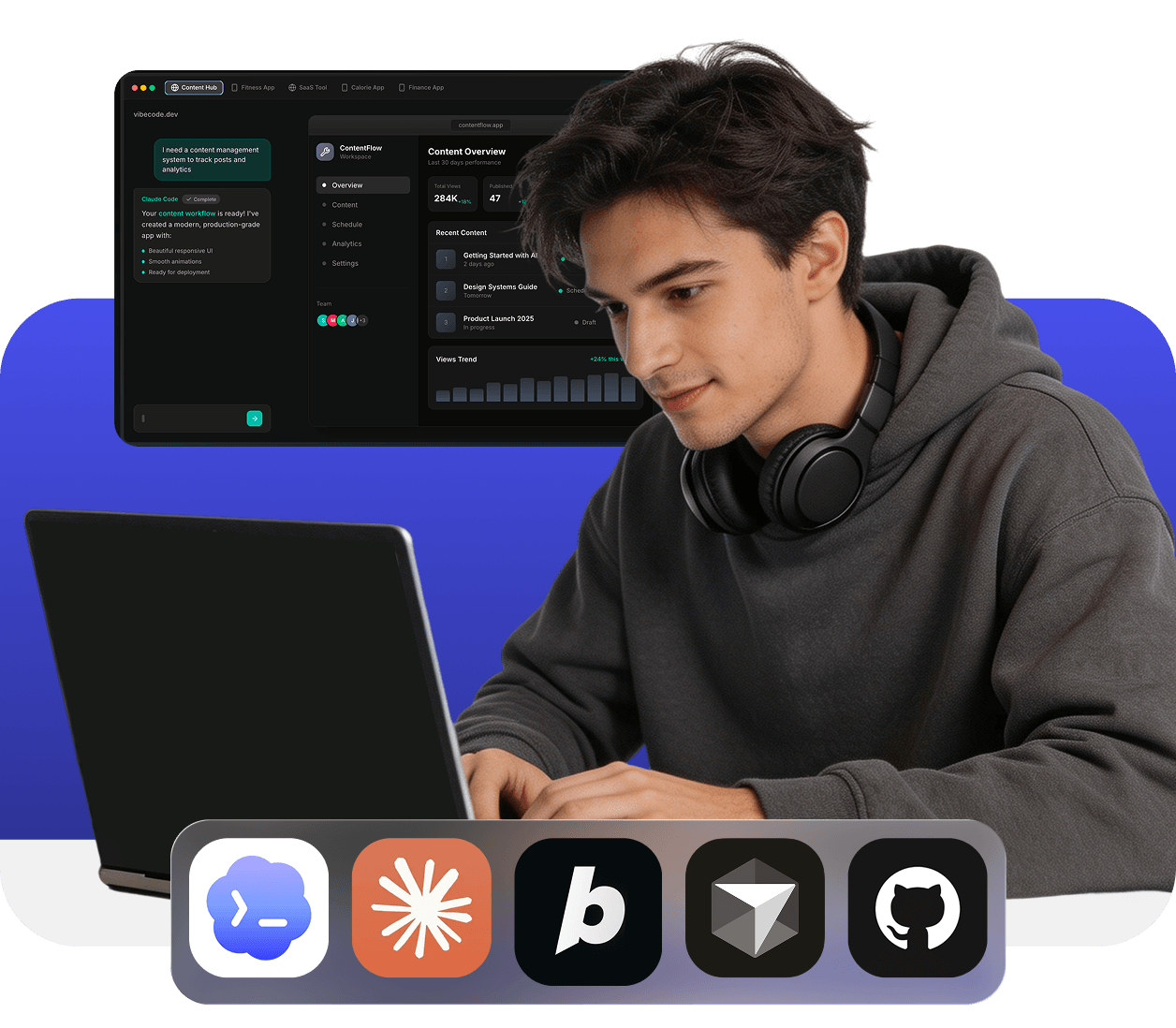
Vibe Coder is a specialist who creates complete digital products using artificial intelligence tools. This is an approach that combines design thinking and modern AI tools to quickly and efficiently turn ideas into working applications.
The course is suitable for:

Newcomers
to quickly enter IT without knowing any code, change your profession, and start earning money on real projects.

Practitioners
to automate routines with AI, create products ten times faster, and grow exponentially.
Why choose the Vibe Coding course?
Low entry threshold
Vibe coding is an approach that you can start with without any programming experience: all you need is interest, attention, and a desire to learn.
Demand and income
The demand for specialists who can create applications using AI is steadily growing, and salaries range from $800-$1,000 and increase with experience.
Flexibility and freedom
Vibe Coding gives you flexibility: you can work remotely, choose projects, and plan your time.
Competitive advantage
Every product needs its own application – the ability to create it quickly through AI forms a competitive advantage and determines the product's success on the market.
Impact on users
Your decisions affect people – you determine how easy and convenient it is for a user to interact with a product.
Earnings will increase
along with experience
+14% According to DOU, salaries in the field are increasing every year
Junior
You will discover a new profession and start as a Junior Specialist.
From $800+
middle
You have more than one year of experience and several projects in your portfolio
From $1300+
Senior
You have more than 4 years of experience, advanced skills and large cases in your portfolio
From $2500+
AI is the new standard of the profession
Our program -
AI-native
While others only add a module on AI, we structure our training so that AI is a fundamental element of all areas.
We don't just teach technology - we adapt students to a reality where AI is already the standard of the profession.
Our students work with AI tools every day, integrating AI into all stages of work.
We teach them to think like specialists who can automate, optimize and accelerate work using modern technologies.


Real experience and lots of practice

Practice on real tasks and projects
Create full-fledged products "from scratch", immerse yourself in large, complex projects, work with real scenarios that are as close as possible to commercial development.
So you enter the market not as a beginner, but as an early-middle level specialist.

Teacher assistance
Our teachers are experienced developers who will help you create high-quality and professional applications.

Own learning platform
Lesson records, performance statistics, assignments and learning materials, support — everything you need for convenient and effective learning.
Course program
Introduction to Artificial Intelligence and Digital Products3 Topics
- What is AI?
- Areas (ML, CV, NLP, generative AI)
- Key terms: model, hint, context, token, result
Generative AI, LLM and principles of operation of modern models4 Topics
- How does an LLM work?
- Hallucinations
- Temperature and context
- Strengths and Weaknesses of LLM
Prompt Engineering: the basics of task setting for AI3 Topics
- Structure of a good prompt: purpose, context
- limitations
- Result format. Zero-shot, one-shot, few-shot
Verification, ethics, security and responsible work with AI3 Topics
- Why check AI answers?
- Methods for checking the result
- Ethics and data privacy
What is Vibe Coding and how does it differ from classic development?2 Topics
- Evolution of approaches: manual programming → low-code → AI-assisted → Vibe Coding.
- Advantages and limitations.
Vibe Coding tools and a map of modern AI workflow10 topics
- ChatGPT
- Gemini
- Claude
- Cursor
- GitHub
- Copilot
- Bolt
- Lovable
- Claude Code
- Codex
What different types of applications consist of7 topics
- Static page
- Interactive front-end
- Full stack
- Database-backed
- Admin panel
- AI-enabled application
- Typical user scenarios
Web application architecture: browser, front-end, back-end, database, deployment4 Topics
- How the web application works
- The role of each level
- Data flow
- Where errors occur
HTML Basics to Understand the Structure of AI-Generated Code4 Topics
- HTML document structure
- Basic tags
- Forms
- Reading and editing AI-generated HTML
CSS Basics for Understanding Interface Design6 topics
- Selectors
- Colors
- Fonts
- Box model
- Flexbox
- Grid at the basic level
A JavaScript base for understanding application logic8 topics
- Variables
- Data types
- Conditions
- Cycles
- Functions
- Arrays
- Objects
- Reading AI-generated JavaScript
JavaScript in the interface: DOM, events, forms and data storage4 Topics
- Working with DOM
- Events (click, input, submit)
- Forms and Validation
- LocalStorage
Reading, explaining, and fine-tuning AI-generated code3 Topics
- Reading unfamiliar code
- Make small changes without breaking the system
- Compare code versions
Git for Safe Vibe Coding5 topics
- Version Control
- Repository
- Commit
- History
- Save the working state and return to the previous version.
GitHub and basic student workflow6 topics
- Clone
- Push
- Pull
- Branch
- README
- Using GitHub with Cursor and GitHub Copilot
Design Thinking for Vibe Coding: Problem, Audience, MVP5 topics
- Problem statement
- Target audience
- User need
- What is an MVP and how to reduce an idea to a feasible first release
- Feature prioritization
Application design: user flow, screens, acceptance criteria6 topics
- User flow
- Screen map
- Feature list
- Data objects
- Acceptance criteria. Task decomposition for AI
- When to use Bolt/Lovable vs. Cursor and GitHub Copilot
Building the Front-End of an Application with Cursor and GitHub Copilot7 topics
- Front-end project structure
- Basic screens
- Interface components
- Navigation
- Forms
- Empty/loading/error state.
- UI improvements through AI prompts
Back-end basics for full stack application5 topics
- The role of server-side logic
- Structure of a simple API
- Routes and endpoints
- CRUD operations
- Data validation
Database layer and working with data8 topics
- Relational and NoSQL approach
- Tables
- Recordings
- Fields
- Connections
- Data schema
- Connecting back-end to database
- Seed data
Integration of front-end, back-end and database into a full stack application4 Topics
- Linking the interface to the API
- Receiving and sending data
- Syncing UI and State
- Network error handling
Testing, debugging, and refactoring an AI-generated application4 Topics
- Finding errors in console and terminal
- Debugging workflow
- Quality checklists
- Common front/back-end and database integration mistakes
Deployment, publishing and maintenance of the application2 Topics
- Deployment
- Publishing and maintaining the application
Claude Code and Codex: the next level of AI-assisted and agentic development4 Topics
- What is Claude Code and Codex?
- Analysis of the existing AI agent project
- Debugging repoinstructions
- Comparison of Claude Code, Codex, Cursor and GitHub Copilot
Final project: creating a complete full stack application5 topics
- Selecting a topic
- Formation of MVP
- User flow and feature set
- Implementation front-end + back-end + database
- Preparing for deployment, creating a README

122 Topics

6 months
After the course, your resume will look like this:

Position
Vibe-code Developer
Skills
- Work with ChatGPT and Gemini
- Work with Cursor, GitHub, Copilot, Claude, Codex
- Prompt Engineering
- Creation of the structure of the application
- Front-end development
- Back-end development
- Work with the database
- Front-end, back-end and database integration
- Publication of the application
- Testing and debugging
- Using Git and GitHub
Tools
-
 ChatGPT
-
 Gemini
-
 Cursor
-
 GitHub
-
 Copilot
-
 Claude
-
 Bolt
Bolt
-
 Lovable
-
 Codex
Codex
Frequently Asked Questions
Who is the Vibe coding course suitable for?
The Vibe Coding course is suitable for entrepreneurs, freelancers, marketers, designers, and anyone who wants to implement their ideas faster without deep technical knowledge. It will also be useful for IT beginners who want to understand the modern approach to creating digital products using AI tools. Even without programming experience, you can learn to create simple applications, automations, and MVP projects.
